The Rhodes 22 Discussion Group

R22RumRunner at aol.com
hull deck joint reseal questions
2013-05-01; 15:04:54 EDT
Member Since
2002-09-17
Posts: 4946
Graham,
Just a caution here. Your hull if I remember correctly is a 77 model. Back
in those days Stan had other firms doing his fiberglass work. That's part
of the  reason he won't recycle a hull that old. Many of the problems you
encountered  are no longer problems with the newer hulls.

Rummy


In a message dated 5/1/2013 10:35:47 A.M. Eastern Daylight Time,
gstewart8 at cogeco.ca writes:

Mike:

The picks might work fine. This is really a trial and error process.  What
works partly depends on what the sealant is like. Silicone might come  out
in
longer pieces but other types are more tenacious and will probably  have to
be cut or scraped out as it tends to crumble. The concave shape of  the hull
makes it easier to get the tool in the slot. You might try  protecting the
any visible surface with tape. If you try the hacksaw blade  you can get a
plastic handle for a few bucks  that will make life  easier for you. I would
be reluctant to put anything in the slot that does  not completely compress.
As that might simply hold the gap open. I think  the trick is to get the
sealant way up inside and then compress the join  before the sealant cures.
You will not get as good a seal if you wait for  it to cure even though some
like Don Casey suggest a two-stage process of  tightening it down moderately
until the sealant sets and then more firmly  afterwards. Mind you, he is
talking about deck hardware where you have big  bolts with backing plates
that allow you to apply heavy compressive forces.  Others are very critical
of that approach and I happen to agree with them.  I want the sealant to
spread out and fill all voids and I can't see that  happening once it has
set. Neither can I see how the sealant will adhere to  the surfaces once it
has set even if you could apply enough compressive  force to make it spread.

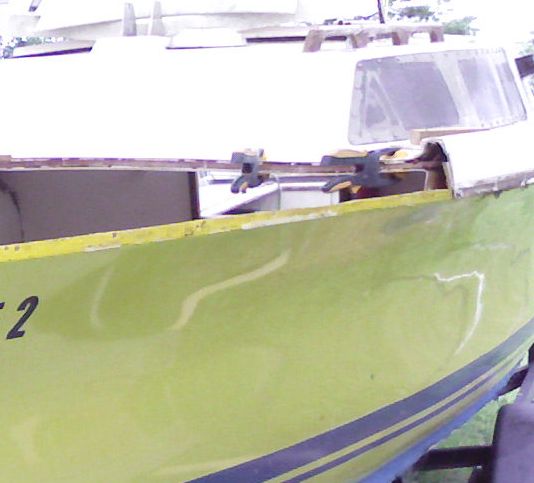
When I removes the foredeck of my boat I was  able to expose the hull deck
join and found that the sealant has been  applied sparsely and with
significant gaps. If your boat is like mine,  careful installation of the
sealant will produce much better results than  the original. The hard part,
but most critical, is getting the old stuff  out.

By the way, if you look at a cross section of the hill-deck join  (see
attached photos) you will see that the plywood core at the edge of the  deck
is exposed to anything that gets up the slot - whether water of bugs -  I
had
both. So the problem is not just a matter of a few splashes of water  inside
the boat, it is also a matter of possible core rot and bug  infestation. So
a
good seal is important. Using a sealant with good  adhesive qualities will
also strengthen the whole boat. The strongest is  5200 but that stuff is
impossible to remove if that ever becomes necessary.  If it is done well,
removal should not be necessary so it might be the most  permanent solution
but the stuff worries me. It is another one of those  double-edged swords.

As an aside, you will also see from the photos  that the plywood core
literally hangs on the outer skin with some kind of  caulking and the inner
liner then hangs onto the plywood core. There is no  structural support that
I could find. So, all of the downward force is  pulling the sandwich
construction apart. Even the adhesive between the  layers of the plywood had
given way. I hope that later model boats use  better plywood. With flexing
over the years it can all come apart.   When I removed the foredeck on my
boat I found that the caulking holding  the plywood to the outer skin and
liner was very sparse and in places not  even touching both surfaces. I
could
pull the liner off and remove the  plywood with my hands. Hence the spongy
deck. You can see the delamination  in the close up photo. Of course this
kind of "fix" was extreme and  ultimately was unnecessary once I knew what
was happening inside the core  but at least it provides some photos of what
is under the skin of the deck  for those who might have a spongy deck and
are
wondering about the options  to fix it. As you might guess, putting it all
back together was a major  pain. I wish I had know then what I know now. It
would have saved me a ton  of work. On the other hand I now have a foredeck
that is as solid as  concrete and probably able to pierce a steel hull -
which is nice for a  change.

BTW, I have a vent in the cabin top that once removed gave me a  view of the
core at least in that area. It appears to me that the top is  made much
better with a core that is over one inch thick. I saw no  indication of
delamination, thank goodness.

Graham
See the original archive post
Sending Post:
Your post is being sent...