The Rhodes 22 Discussion Group
< prior
Back to Month
Go to Thread

The Rhodes 22 Email List
Window replacement update
2015-06-03; 13:48:04 EDT
Member Since
2014-05-06
Posts: 3821
Graham: i would consider a black neoprene gasket with small through bolts (or machine screws).  I think it would look good and be less likely to leak or fall off.  Down here in florida when adhesive gets hot it just melts and lets go. Just MHO. :-)
Bob (palatka)
See the original archive post
> On Jun 3, 2015, at 12:31 PM, The Rhodes 22 Email List <rhodes22-list at rhodes22.org> wrote:
>
> Mary Lou:
>
> I will paint the inside of the acrylic panel everywhere except where the
> openings will be. I intend to do this by removing the protective paper
> everywhere except the port opening, then paint the panel and finally remove
> the paper over the opening once the panel is installed. In the picture I
> provided with the panels painted the paper covering is still over the port
> area so it looks solid. You can't see the paper covering in the picture. I
> could remove the paper before I install the panel but it seems sensible to
> leave that area protected from scratches and any sealant that might get
> smeared on it during installation.
>
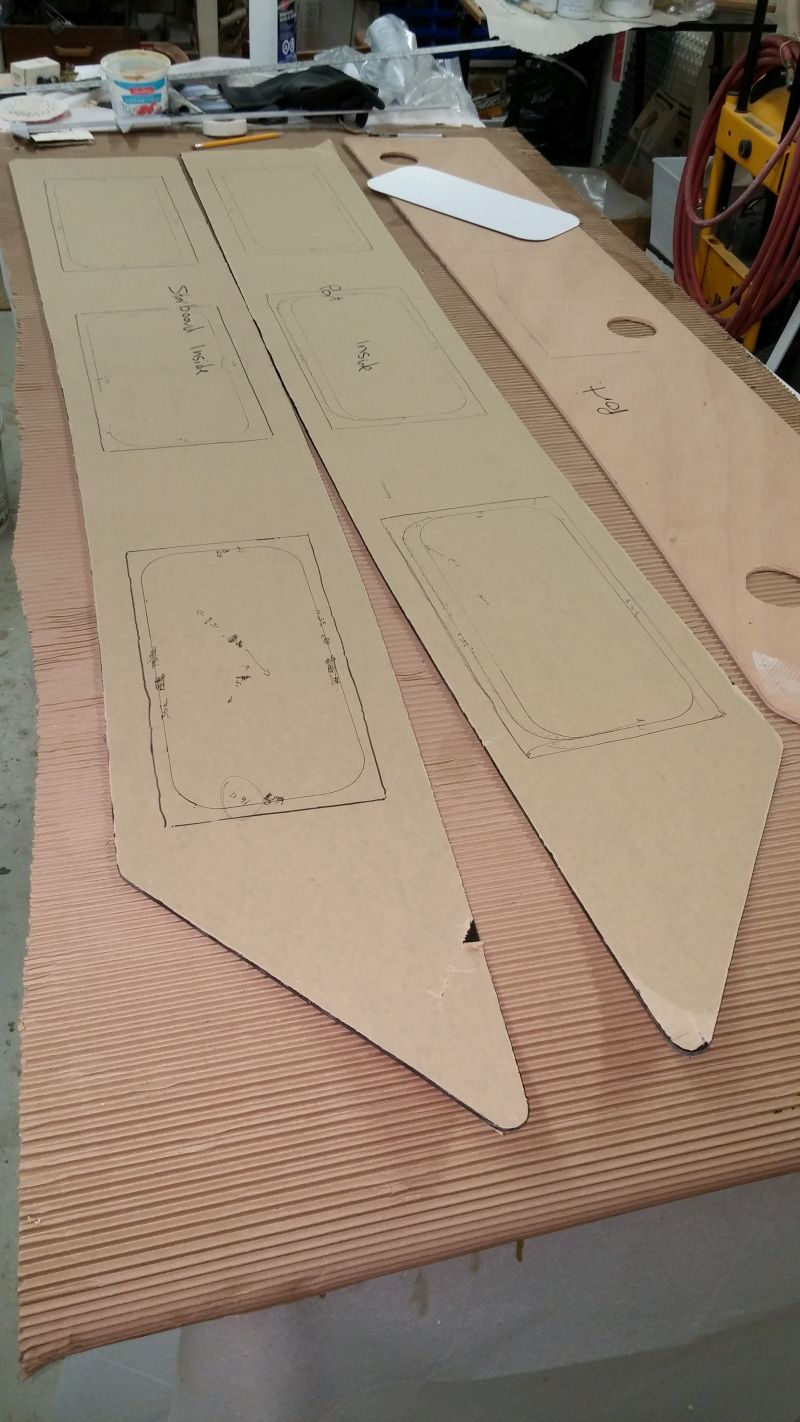
> I have attached a picture showing the plywood template, for the panel, the
> Formica template (white) for the opening and the two acrylic panels with the
> protective paper still on and the opening areas marked.
>
> The acrylic panel is deep tinted so perhaps nothing will show through but
> the tinting is not opaque and I suspect that in sunlight the grey tape and
> white cabin will show. I don't have a spare piece of the tinted acrylic to
> test this as I had the dealer cut the original panel for me using a plywood
> template that I provided. I should have asked for some scrap piece. I did
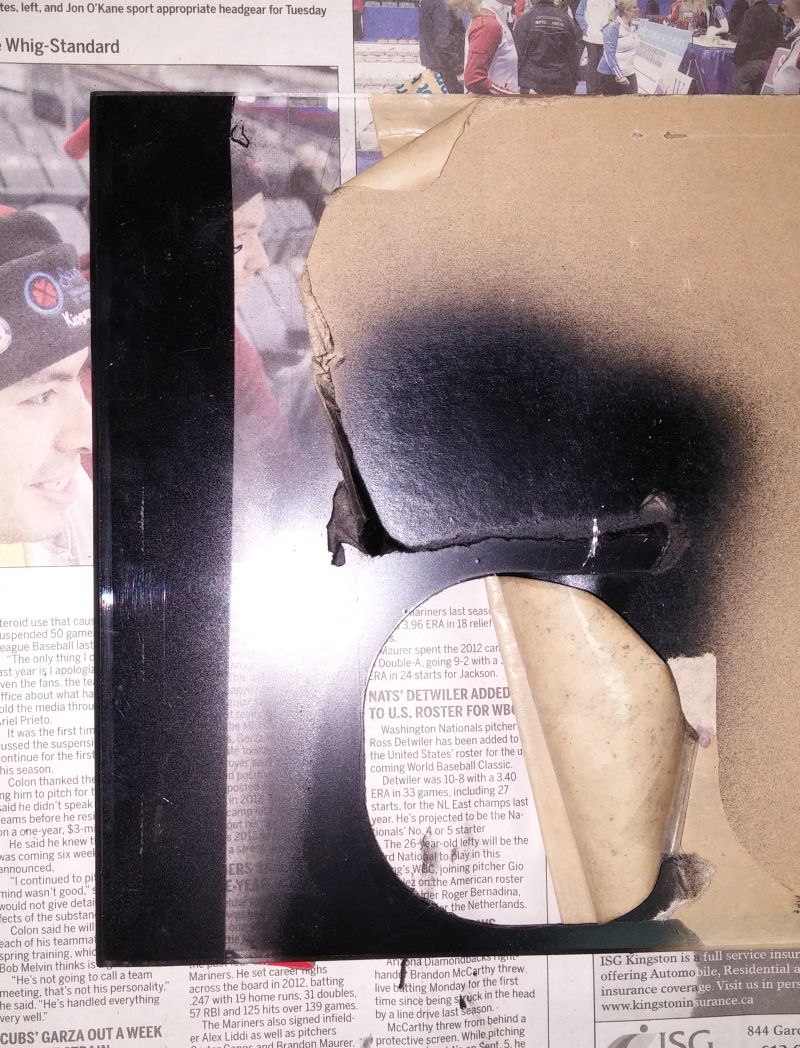
> have some clear acrylic that I used to test painting and the cutting and
> removal of the paper. I have attached a picture of the clear acrylic,
> partially painted and with the opening protective paper pealed back on both
> sides. That might make what I am describing a litter easier to follow.
>
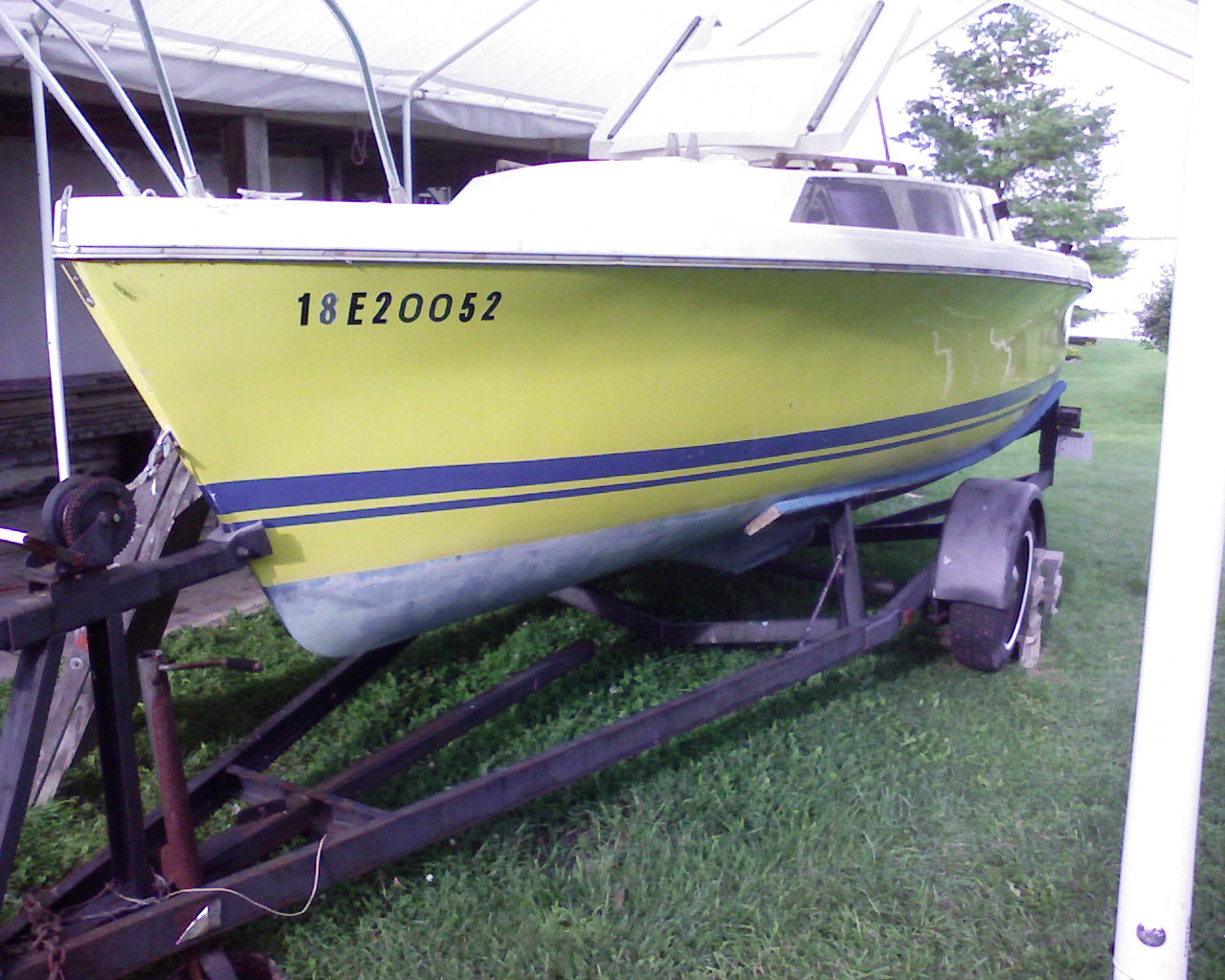
> I have attached a picture of the boat with the lexan windows that I attached
> back in 1995. The picture was taken 20 years later when the paint had pealed
> and you can see the cabin and peeling paint under through the Lexan. Hence
> my obsession with using the right paint.
>
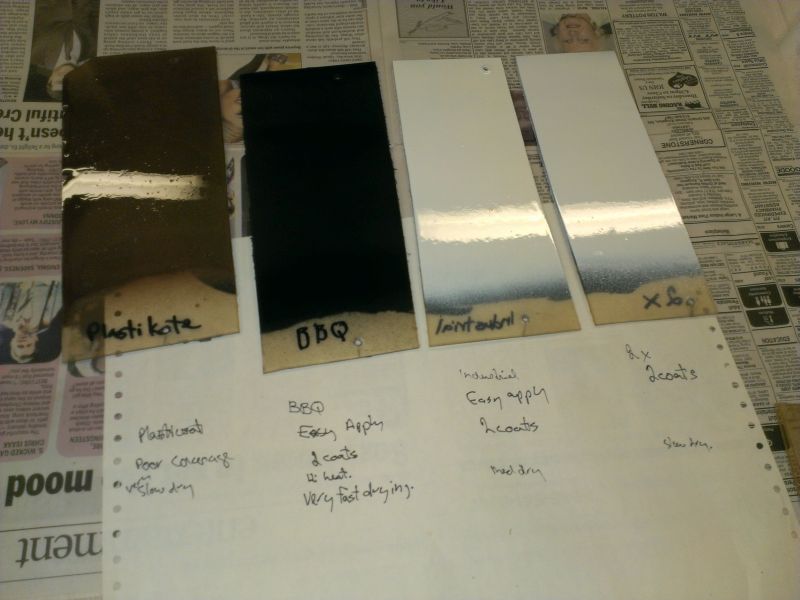
> For more about my paint selection I have attached a picture of panels of
> Lexan coated with various paints along with observational comments. I think
> it demonstrates fairly well why the barbeque paint seemed superior for this
> task.
>
> I hope that helps.
>
> Graham
>
>
> -----Original Message-----
> From: rhodes22-list-bounces at rhodes22.org
> [mailto:rhodes22-list-bounces at rhodes22.org] On Behalf Of The Rhodes 22 Email
> List
> Sent: June-02-15 11:51 AM
> To: The Rhodes 22 Email List
> Subject: Re: [Rhodes22-list] Window replacement update
>
> Nice write up Graham but I must be missing a sentence or an email or
> something.
>
> If you are going to have Lexan windows, why paint them? I read the part
> about "to make sure that the grey tape and white sides of the cabin did not
> show through" but if you are painting the whole window why use Lexan at all?
> Or can you still see out through the paint? do the windows let light in?
>
> I'm confused.
>
> Mary Lou
> 1991 R22 Fretless
> (recycled 1998)
> still on the hard
> but just about ready
> to splash for the season
> in Rock Hall, MD
>
>
>
> At 11:16 AM 6/2/2015, you wrote:
>> For those who are interested in replacing cabin ports with acrylic
>> panels, I thought I would bring you up to date on my highly scientific
>> experiments using the method of attaching windows without using any
>> hardware.
>>
>> My experiments were intended to demonstrate for me the strength of a
>> joint using Dow Corning silicone # 795 and 3M brand tape VHB 4991 and
>> the paint I intended to use to coat the inside of the acrylic panel.
>>
>> First, I joined some pieces of Lexan I had using the tape and the
>> sealant and let it sit for 48 hours for the sealant to cure. At  48
>> hours the sealant is about 90% cured but it continues to cure for 72
>> hours. I couldn't wait that long. I attached a small piece of lexan
>> (about 1.5" x 3") to a larger piece at a corner. I messed up the
>> sealant with the result that I got some on top of the tape - which
>> seems like a distinct possibility when I do the large panels so I was
>> curious to see what effect that had. By leaving the smaller piece
>> extending beyond the larger piece I had a tab that I could use to peal
>> the pieces apart. I have attached a picture of what I call the "flex
>> test".
>>
>> By holding the main piece down and lifting up on the tab I was able to
>> bend the panels far beyond any curvature on the cabin side of the boat
>> without any sign of the joint letting g. Also. the joint had enough
>> flex that the panels could move past each other slightly to allow for a
>> nice even bend. When I bent the joint to the maximum the lexan broke
>> (see photo) before any sign that the joint was weakening. Lexan is very
>> flexible and strong so that seemed to me to be a good sign although I
>> should note that the Lexan was only 3/16"
>> thick. I figure that if I can't break the join even on small pieces
>> without destroying the Lexan, that has to be a very strong and flexible
> joint.
>>
>> As an aside, the sealant has a useful life of one year. When I ordered
>> mine it was already 8 months old and expired in March 2015.
>> I called 3M last fall to see if there was any way to extend the life of
>> the material. The technical support person told me to seal it up in
>> plastic and put it in my freezer - which I did. He then told me to test
>> it before using it by laying out a bead and letting it sit for 3 hours.
>> If it skinned over, it was good but if it stayed wet it will never cure
>> - even though it looks fine coming out of the tube.
>> I Had thought that old material would harden in the tube so that was
>> potentially very useful to know. I have read online where others
>> complained that this sealant never cured and I expect they were using
>> material that was too old. In my case it appears the freezing worked as
>> the sealant cured up nicely.
>>
>> Although the acrylic panels I am using are dark tinted, I wanted to
>> make sure that the grey tape and white sides of the cabin did not show
>> through so I needed to find a suitable paint to coat the inside. I
>> wanted something that would adhere tenaciously to acrylic so that in
>> turn the tape and sealant would adhere to the paint. I also wanted
>> something that would apply by spray to give a perfectly even coat and
>> preferably was fast drying. Articles I read advised using engine
>> exhaust paint. The particular types suggested were not available
>> locally and a ridiculous price to order by mail across the Canada/US
>> border. Also I noticed that application instructions for similar paints
>> available locally specified that it dries easily but does not cure
>> until it is brought up to a high heat. That , of course , is not going
>> to happen with acrylic so I was left wondering how it would work in an
>> uncured state.
>>
>> I experimented with a number of paints - especially paints that are
>> intended for plastic. The first time I did this in 1995 I used some
>> sort of enamel that subsequently pealed of even though it was between
>> the Lexan and the cabin side. It was thick, soft and had poor adhesion
>> with Lexan. So I wanted something better than that.  I noticed that the
>> paints I was testing went on thick and took a long time to dry. They
>> also scratched off too easily for my liking. I then tried some barbeque
>> paint that I had. The paint is intended for high heat applications but
>> had a maximum temperature of 600 degrees
>> - which is much lower than the exhaust paint but still much higher than
>> anything the boat will ever face before I am jumping overboard and it
>> does not require heat to cure. It also sprays on beautifully in thin
>> coats, dries to touch in a few minutes - no dust problems - and can be
>> recoated several time within an hour. That meant that I could apply
>> multiple thin and even coats. It give!
>> s a satin finish rather than high gloss which I thought might make  a
>> better surface for the tape to adhere to. I first painted pieces  of
>> Lexan and clear acrylic and let it sit for about 3 months to see  if
>> there was any indication of incompatibility between the paint  and the
>> plastic. There was no sign of incompatibility that I could see.
>>
>> I tested the adhesion of the paint by trying to scratch it off soon
>> after application and after several months and by applying a variety of
>> tapes - duct tape and packing tape, house wrap tape etc, - and then
>> peal it back both while the paint was fresh and after the tape had been
>> in place for several months. As the flex test shows I also tried
>> adhesion with the double-sided tape and, as noted, the lexan broke
>> before the seal showed any sign of letting go. I also applied sealant,
>> let it cure , and tried to remove it by pealing it back.
>> The "paint test" is shown in an attached picture. It shows packing tape
>> that had been left in place for several months. The tape was firmly
>> attached but came off cleanly leaving the paint firmly attached to the
>> Lexan. Scratching the paint with a sharp object left a scratch, of
>> course,  but did not remove any of the surrounding paint. So I think
>> this is a good paint for this application.
>>
>> To prepare the windows, I cut the acrylic panels from a 1/8" plywood
>> template, routed a slight bevel on the outside edges, laid out where
>> the opening in the cabin were, made a template for consistent openings
>> made out of Formica (which works well because it is thin and hard) and
>> then cut the protective paper around what will be the openings using
>> the template and exacto knife. I then removed all the protective
>> covering except where the openings will be and painted the pieces with
>> four thin coats of barbeque paint. I have attached a photo of the
>> painted pieces.
>>
>> After the acrylic is attached to the boat I will remove the masking
>> tape on the outside of the acrylic panes, the tape on the cabin sides
>> and remove the protective paper from the outside of the panels and the
>> inside of the open part.  I tested whether I would be able to peel off
>> the inside sections once it had been painted over especially given that
>> it will be difficult to raise an edge once the panels are installed. I
>> found that if I apply a strip of packing tape to the covering paper
>> leaving the end folded over so I can grab it, when I peal it back the
>> tape holds sufficiently to raise the protective paper cleanly avoiding
>> the need to scratch up an edge.
>> Hopefully that works in the real life situation. I would hate to have
>> acrylic panels permanently attached with paper coving the opening that
>> I can't remove.
>>
>> So I have chosen all the materials and tested them as best I can for
>> suitability. I have also worked out a temporary clamping system to hold
>> the panels in place while the tape and sealant cure. That might be
>> unnecessary but given the curve of the cabin I don't want to take a
>> chance on that part. I have masked the boat around the edge of the
>> acrylic and sanded the paint on the cabin side so that is flat , smooth
>> but dulled (220 grit). Now all that is left is to attach the actual
>> panels and frankly that is what worries me most. While online
>> instructions suggest applying the tape and sealant to the panel and
>> then apply the panel to the boat, my thinking is that because the cabin
>> side is a compound curve I would be better to apply the tape and
>> sealant to the cabin and then press the panel into place.
>>
>> Time matters. I don't have forever to apply the sealant and remove the
>> tape cover before pressing the panel on and worse still, I only get one
>> chance to get the panel in the exact location. There is really no room
>> for error. I have "rehearsed" placing the panel with my wife but that
>> was without any of the tape or sealant. The cabin side has a moulded in
>> edge at both the bottom and the aft end that are very helpful guides
>> but one still need to make sure from the moment of first touch that
>> everything is aligned perfectly so that the rest will wrap into place
>> exactly where it is supposed to be. My hope is that I can rest the
>> bottom edge and aft corner against the little raised edge first and
>> then wrap the piece up into place at the top.
>>
>> If anyone has any clever ideas about how I could make the process idiot
>> proof I would be forever grateful.  The idea of having to use a chisel
>> and grinder to remove the misaligned panels has no appeal to me at this
>> juncture. I think I will need a very good shot of Rummy's Mont Gay
>> medicine to calm my nerves first.
>>
>>
>> Graham
>> -------------- next part -------------- A non-text attachment was
>> scrubbed...
>> Name: Barbeque paint.jpg
>> Type: image/jpeg
>> Size: 178369 bytes
>> Desc: not available
>> Url :
>> http://www.rhodes22.org/pipermail/rhodes22-list/attachments/20150602/91
>> 6312ae/attachment.jpg
>>
>> -------------- next part -------------- A non-text attachment was
>> scrubbed...
>> Name: Window flex test.jpg
>> Type: image/jpeg
>> Size: 52391 bytes
>> Desc: not available
>> Url :
>> http://www.rhodes22.org/pipermail/rhodes22-list/attachments/20150602/91
>> 6312ae/attachment-0001.jpg
>>
>> -------------- next part -------------- A non-text attachment was
>> scrubbed...
>> Name: Window paint test.jpg
>> Type: image/jpeg
>> Size: 82200 bytes
>> Desc: not available
>> Url :
>> http://www.rhodes22.org/pipermail/rhodes22-list/attachments/20150602/91
>> 6312ae/attachment-0002.jpg
>>
>> -------------- next part -------------- A non-text attachment was
>> scrubbed...
>> Name: Windows painted.jpg
>> Type: image/jpeg
>> Size: 54671 bytes
>> Desc: not available
>> Url :
>> http://www.rhodes22.org/pipermail/rhodes22-list/attachments/20150602/91
>> 6312ae/attachment-0003.jpg
>>
>> __________________________________________________
>> To subscribe/unsubscribe go to
>> http://www.rhodes22.org/mailman/listinfo/rhodes22-list
>>
>> For the list Charter and help with using the mailing list and archives
>> go to http://www.rhodes22.org/list
>> __________________________________________________
>>
>>
>> -----
>> No virus found in this message.
>> Checked by AVG - www.avg.com
>> Version: 2015.0.5961 / Virus Database: 4355/9924 - Release Date:
>> 06/02/15
>
> __________________________________________________
> To subscribe/unsubscribe go to
> http://www.rhodes22.org/mailman/listinfo/rhodes22-list
>
> For the list Charter and help with using the mailing list and archives go to
> http://www.rhodes22.org/list
> __________________________________________________
> -------------- next part --------------
> A non-text attachment was scrubbed...
> Name: Windows with openings marked (2).jpg
> Type: image/jpeg
> Size: 173689 bytes
> Desc: not available
> Url : http://www.rhodes22.org/pipermail/rhodes22-list/attachments/20150603/51cc1373/attachment.jpg
> -------------- next part --------------
> A non-text attachment was scrubbed...
> Name: Sailboat under cover Aug 08.jpg
> Type: image/jpeg
> Size: 242176 bytes
> Desc: not available
> Url : http://www.rhodes22.org/pipermail/rhodes22-list/attachments/20150603/51cc1373/attachment-0001.jpg
> -------------- next part --------------
> A non-text attachment was scrubbed...
> Name: Paint for windows comparison.jpg
> Type: image/jpeg
> Size: 76907 bytes
> Desc: not available
> Url : http://www.rhodes22.org/pipermail/rhodes22-list/attachments/20150603/51cc1373/attachment-0002.jpg
> -------------- next part --------------
> A non-text attachment was scrubbed...
> Name: Paint and peal test.jpg
> Type: image/jpeg
> Size: 210408 bytes
> Desc: not available
> Url : http://www.rhodes22.org/pipermail/rhodes22-list/attachments/20150603/51cc1373/attachment-0003.jpg
> __________________________________________________
> To subscribe/unsubscribe go to http://www.rhodes22.org/mailman/listinfo/rhodes22-list
>
> For the list Charter and help with using the mailing list and archives go to http://www.rhodes22.org/list
> __________________________________________________
Message to Webmaster:
To use your email application to send a messsage to the webmaster rather than this form, .
Post to the Rhodes 22 Email List:
Sending Post:
Your post is being sent...